

Want a fresh haircut that looks stylish without being too bold? A Low Taper Fade might be exactly what you need. It keeps the hair longer on top while gradually shortening it around the ears and neckline. This creates a clean, natural look that suits school, work, and everyday life. It is also a great choice if you want to try a modern haircut without changing your entire style.
The best part is how easy it is to customize. You can pair it with straight hair, natural waves, messy curls, or a textured top. It also works well with a beard and different hair lengths. Whether you prefer a simple look or something more modern, there is a style for you. With the right cut and basic care, you can keep your hair looking neat without spending hours styling it every day.
What Is a Low Taper Fade?
A low taper fade is a haircut in which the hair gradually becomes shorter around the lower edges of the head, especially the sideburns and neckline. The blend stays close to the natural hairline, leaving most of the upper sides longer.
Unlike a dramatic high fade, this haircut doesn’t remove much hair from the sides. The result is a subtle transition that looks neat without making the scalp overly visible.
The low taper fade hairstyle is also versatile. You can combine it with a textured top, short curls, straight hair, waves, or a classic side part.
The exact finish depends on how short your barber cuts the lowest section. You can request a soft blend that leaves some hair visible or a sharper finish that reaches the skin.
What Does “Taper” Mean?
A taper means gradually shortening the hair as it approaches an edge, such as the sideburns or neckline. Instead of leaving a sudden line between two lengths, the barber blends them together.
A fade uses the same general idea but often creates a stronger transition to very short hair or bare skin. In everyday barbering, the terms overlap, and some professionals use “taper fade” and “fade” differently.
The word “low” describes where the transition begins. A low taper stays near the ears and nape rather than climbing high up the sides.
This combination makes a low taper fade for men a useful choice when you want clean edges while retaining your natural hairstyle.
Difference Between Low Taper Fade, Low Fade, and Taper Fade
These haircuts share similar techniques, but they don’t always remove the same amount of hair. Understanding the differences helps you explain exactly what you want.
Low Taper Fade
A low taper fade focuses on the sideburns, the area around the ears, and the neckline. Most of the hair above these areas remains at its existing length.
It’s a good option if you want a natural finish that works at school, in the office, or in everyday settings.
Low Fade
A low fade usually creates a more continuous blend across the lower sides and back. It can remove more hair than a localized taper, creating greater contrast between the sides and the top.
Choose this option if you prefer a more noticeable fade rather than a subtle cleanup around the edges.
Taper Fade
A taper fade gradually blends the hair around the edges, but its exact placement depends on the style requested. It can be low, mid, or high.
A low taper fade keeps this transition near the bottom of the head. A mid or high taper starts higher and creates a more noticeable change in the side profile.
Why the Low Taper Fade Is a Smart Choice
The low taper fade offers a balance between a traditional haircut and a modern style. It keeps the sides tidy without forcing you to cut the top short.
It’s especially practical for beginners because you can keep your current hairstyle and change only the edges. If you want more contrast later, your barber can adjust the next cut.
Clean Appearance:
A low taper creates neat sideburns and a tidy neckline. The gradual fade removes uneven edges without making the whole haircut look drastically different.
You can also request a natural hairline instead of a sharply squared outline if you prefer a softer finish.
Professional Look
The haircut can look polished without being overly bold. This makes it suitable for many offices, colleges, and other settings with grooming expectations.
For a conservative finish, keep the blend low, avoid excessive scalp exposure, and choose a simple style on top.
Easy to Maintain
Most of the hair remains at a useful length, so you don’t need to style every section carefully. A small amount of hair cream or matte clay may be enough to shape the top.
However, a very sharp skin finish needs more frequent touch-ups than a softer taper.
Grows Out Nicely
Because the blend is concentrated around the edges, regrowth usually looks less dramatic than it does with a high-contrast fade. The hair gradually returns to a more uniform length.
Your haircut will still lose its sharp outline over time, but a softer taper can remain presentable between barber visits.
Read More: https://goldfaxhion.com/
Who Should Get a Low Taper Fade?
A low taper fade suits many people because it doesn’t depend on one specific hair length or texture. Your preferred top style, natural growth pattern, and barber’s blending technique all influence the result.
Consider these points when choosing your cut:
- Face shapes: Oval and square faces can work well with many variations. Round faces may benefit from some height on top, while longer faces can look balanced with less vertical volume.
- Straight hair: A low taper with a side part, short fringe, or textured top creates a clean shape.
- Wavy hair: Keeping the natural waves on top adds movement without requiring complicated styling.
- Curly hair: A low taper cleans the edges while allowing curls to remain the main feature.
- Thick hair: The barber can reduce bulk around the edges while retaining fullness on top.
- Thin hair: A softer blend and a suitable top length can help avoid excessive scalp exposure.
No haircut automatically suits every face or hairline. Ask your barber to adapt the blend to your hair’s natural direction and the shape you want to achieve.
Best Low Taper Fade Styles for Beginners
You don’t need a complicated design to get a good low taper fade. Start with a style that matches your current hair length and daily routine.
Classic low taper fade: Keeps the top simple and the edges neat. It’s a dependable option for school, work, and everyday wear.
Low taper fade with textured top: Adds movement and a relaxed finish. It works particularly well when you want a modern appearance without a rigid shape.
Low taper fade with curly hair: Preserves curls on top while tidying the sideburns and neckline. Ask your barber to account for shrinkage when cutting your curls.
Low taper fade with straight hair: Pairs well with a side part, short fringe, or slightly messy top. A little styling cream can keep the hair in place without making it look stiff.
Low taper fade with wavy hair: Lets your natural waves provide texture. Keeping some length on top helps the waves maintain their shape.
Low taper fade with short hair: A crew cut, short crop, or buzz cut can look cleaner with a low taper around the edges. This is useful if you want minimal daily styling.
Low taper fade with a beard: A carefully blended sideburn creates a smoother connection between the haircut and beard. Tell your barber whether you want a gradual beard connection or a clear separation.
Low taper fade with a messy top: Leaves the top relaxed and textured while keeping the lower edges controlled. This is a practical modern low taper fade for casual wear.
Low taper fade with medium-length hair: Preserves more styling options, including swept-back hair and loose curls. It works best when the barber blends the sides without removing too much weight.
How to Ask Your Barber
The easiest way to explain a low taper fade is to name the cut, describe the shortest length, and explain how much hair you want to keep.
You can say:
“I’d like a low taper fade around my sideburns and neckline. Keep the blend low, leave most of the sides full, and keep the top at its current length. Please make the transition natural rather than taking the fade too high.”
Then clarify these details:
- Bottom length: Explain whether you want a soft shadow, a very short guard, or a finish that reaches the skin.
- Side length: Tell your barber whether you want the upper sides left full or shortened slightly.
- Top style: Choose a textured top, curls, side part, fringe, or another look.
- Neckline: Request a natural neckline or a softly tapered finish if you don’t want a hard, squared line.
- Sideburns: Explain whether they should blend into your beard or remain separate.
Bring haircut reference photos showing the front, side, and back. A front view alone may not show how high the taper sits or how the neckline looks.
If you’re unsure about the length, ask the barber to start conservatively. You can always remove more hair during the appointment, but you can’t immediately restore length once it’s cut.
How to Style a Low Taper Fade
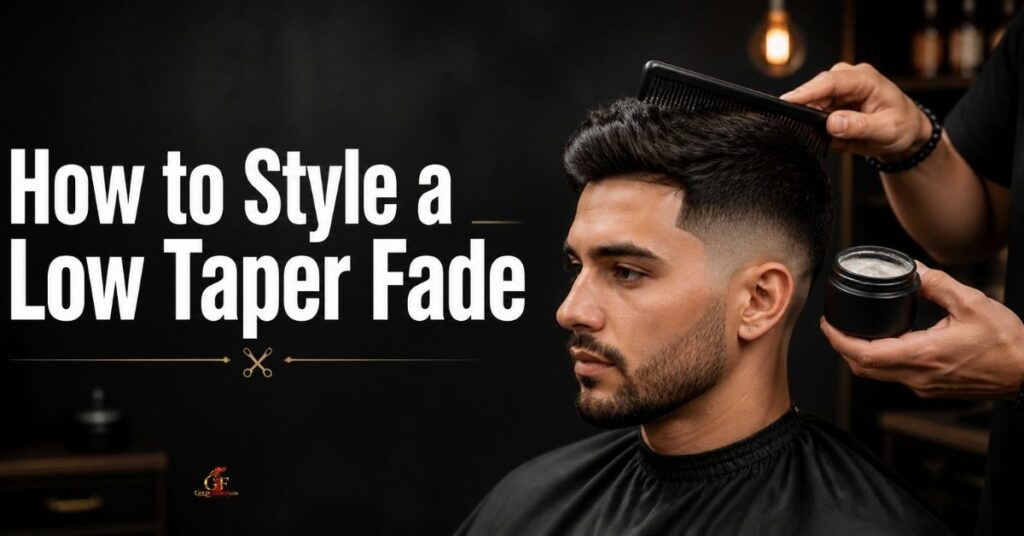
Styling depends mainly on the hair you keep on top. The taper itself needs little attention once the cut is finished.
Follow this simple routine:
- Wash or lightly dampen your hair.
- Gently towel-dry it without rubbing aggressively.
- Apply a small amount of a suitable styling product.
- Use your fingers, a comb, or a brush to create your preferred shape.
- Let the hair air-dry or use a blow-dryer on a suitable setting if you need more volume.
For a textured top, work the product through the hair with your fingers. For a side part, use a comb to establish the direction before the hair dries.
Curly hair often needs more moisture and curl definition than straight hair. Use products that support your natural texture instead of forcing your hair into a style that doesn’t suit it.
Product Guide:
The best products for styling a low taper fade depend on your hair type, desired finish, and the amount of hold you need.
- Matte clay: Useful for textured, messy, or slightly structured hairstyles. It generally creates a less shiny finish.
- Hair cream: Works well for softer control, natural movement, and many wavy or curly styles.
- Pomade: Can help create a polished side part or slicked-back hairstyle. Choose the finish and hold according to your preference.
- Lightweight styling products: May be better for fine or thin hair because heavy products can make it appear flatter.
- Curl cream: Can help define curls and manage frizz when used in an amount suitable for your hair.
Start with a small quantity and add more only if needed. Using too much product can weigh down your hair, make it greasy, or remove the natural texture you’re trying to preserve.
How to Maintain a Low Taper Fade Properly
Low taper fade maintenance is straightforward when you follow a consistent routine. The goal is to keep the hair healthy and the edges tidy without constantly cutting away length.
Book regular barber visits. Many people refresh their taper every two to four weeks, depending on hair growth and how sharp they want the edges to look. A softer finish may last longer, while a skin-level blend can show regrowth sooner.
Wash your hair as needed. Choose a shampoo suited to your scalp and hair type. Curly or dry hair may need a different washing routine from fine or oily hair.
Keep the neckline natural. Avoid repeatedly shaving into the blend at home. Uneven trimming can change the shape and make the next barber visit more difficult.
Maintain the top separately. A low taper doesn’t determine how long the top should remain. Trim split ends or reshape the top when necessary, even if the sides still look good.
Protect your scalp. If close clipping or shaving causes irritation, ask your barber to leave slightly more length and avoid unnecessary repeated passes.
Common Beginner Mistakes
A few small decisions can make the difference between a haircut you like and one that doesn’t match your expectations.
- Asking for a fade without explaining the height: Specify that you want the blend to remain low.
- Choosing the wrong reference photo: Use pictures with a similar hair texture, hairline, and top length.
- Cutting the sides too short: If you want a subtle result, ask your barber to preserve fullness above the taper.
- Ignoring the neckline: The back of the haircut matters just as much as the front.
- Using too much product: Start small to prevent a heavy or greasy appearance.
- Expecting the same result on every hair type: Straight, wavy, and curly hair behave differently when cut.
- Trying to fix the blend at home: Leave detailed clipper work to your barber unless you have the necessary experience.
Cost of a Low Taper Fade
The low taper fade haircut cost depends on your location, the barber’s experience, the shop, and the complexity of the cut. A basic taper may cost less than a detailed haircut that includes a skin finish, beard blending, or extra styling.
Before booking, ask whether the price includes the top haircut, neckline detailing, and beard work. Some barbers charge separately for these services.
If you’re comparing prices, look at the barber’s work and customer reviews rather than choosing on price alone. A clean blend and a well-shaped neckline are important parts of the finished haircut.
You can also ask about the cost of maintenance appointments. Regular touch-ups may be easier to budget for than waiting until you need a complete reshaping.
Final Thoughts
The low taper fade is a versatile haircut that combines clean edges with a natural amount of fullness on the sides. It works with many hairstyles, including short crops, textured tops, straight hair, waves, curls, and beards.
For beginners, the best approach is to keep the first cut simple. Choose a reference photo, explain how short you want the edges, and tell your barber how much length you want to preserve.
With the right cut and a little maintenance, you can keep your hairstyle looking neat without making daily styling complicated.
Frequently Asked Questions
Is low taper fade good for first haircut?
Yes. A low taper fade is a good starting point because it keeps most of the sides full and changes only the lower edges. Ask your barber for a subtle blend if you want a conservative first cut.
Does it work for curly hair?
Yes. A low taper fade with curly hair keeps the curls prominent while cleaning up the sideburns and neckline. Ask your barber to account for shrinkage and preserve the curl shape on top.
Is it allowed in schools?
That depends on your school’s grooming policy. A classic low taper fade is relatively subtle, but check the rules before choosing a skin finish, designs, or a more dramatic variation.
How long does it stay fresh?
A low taper fade often looks sharp for about two weeks and can remain presentable for three to four weeks. The exact timing depends on hair growth, the shortest length, and how neat you want the edges.
Does it need daily styling?
No. A low taper fade with short hair may need only a quick brush or comb. Longer, curly, or textured tops may need a small amount of styling product to maintain their shape.

Noah Daniel Davis is a passionate fashion writer with experience in fashion trends, styling, beauty, and lifestyle. He enjoys creating simple, practical content that helps readers discover new styles and express their individuality with confidence.
